Chuyển đến nội dung chính

Monitoring Featured Snippets - Whiteboard Friday

Posted by BritneyMuller

We've covered finding featured snippet opportunities. We've covered the process of targeting featured snippets you want to win. Now it's time for the third and final piece of the puzzle: how to monitor and measure the effectiveness of all your efforts thus far. In this episode of Whiteboard Friday, Britney shares three pro tips on how to make sure your featured snippet strategy is working.
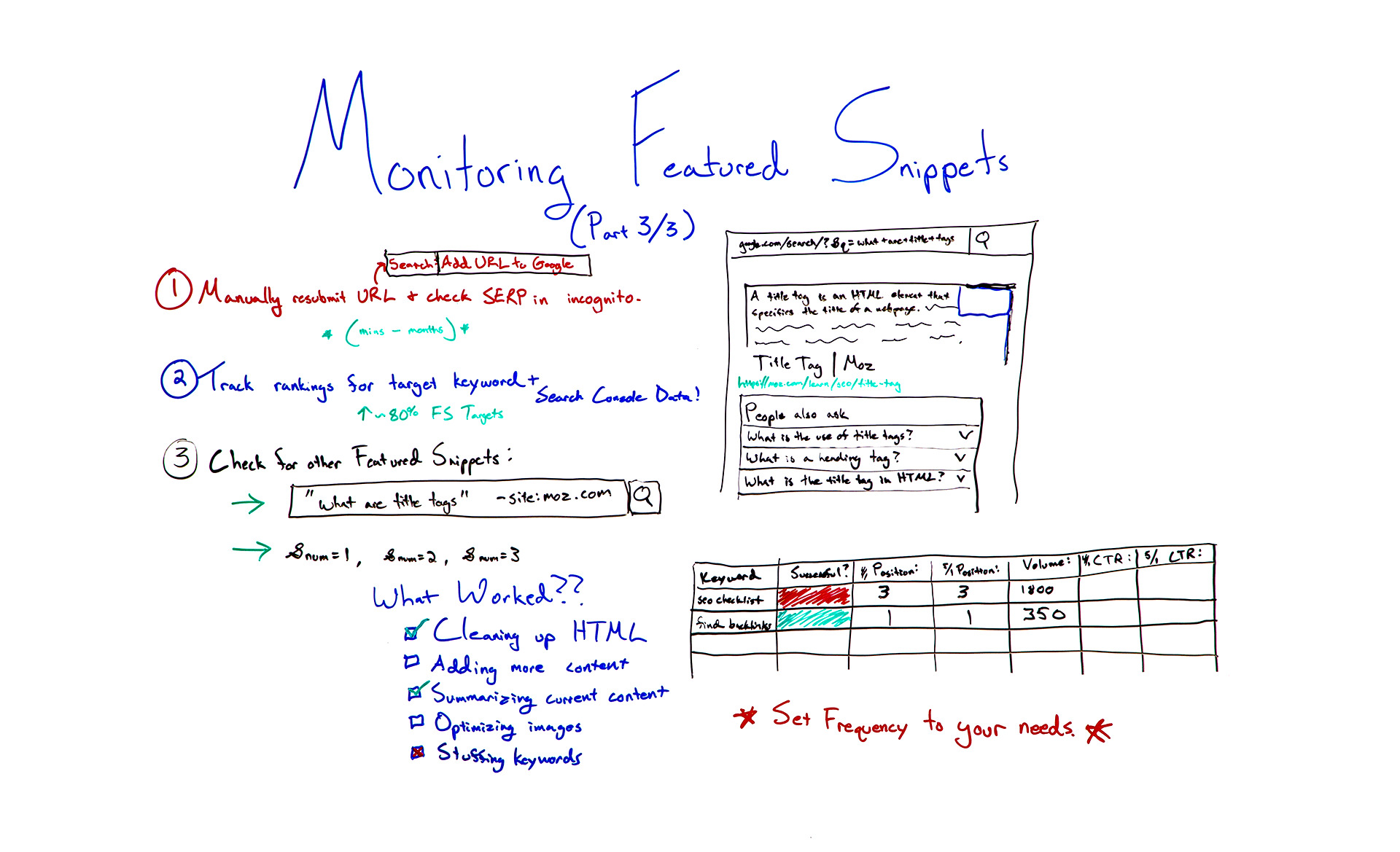
Monitoring featured snippets

Click on the whiteboard image above to open a high-resolution version in a new tab!

Video Transcription

Hey, Moz fans. Welcome to another edition of Whiteboard Friday. Today we are going over part three of our three-part series all about featured snippets. So part one was about how to discover those featured snippet opportunities, part two was about how to target those, and this final one is how to properly monitor and measure the effectiveness of your targeting.

So we'll jump right in. So there are a couple different steps and things you can do to go through this.

I. Manually resubmit URL and check SERP in incognito

First is just to manually resubmit a URL after you have tweaked that page to target that featured snippet. Super easy to do. All you do is go to Google and you type in "add URL to Google." You will see a box pop up where you can submit that URL. You can also go through Search Console and submit it manually there. But this just sort of helps Google to crawl it a little faster and hopefully get it reprioritized to, potentially, a featured snippet.

From there, you can start to check for the keyword in an incognito window. So, in Chrome, you go to File > New Incognito. It tends to be a little bit more unbiased than your regular browser page when you're doing a search. So this way, you'd start to get an idea of whether or not you're moving up in that search result. So this can be anywhere from, I kid you not, a couple of minutes to months.

So Google tends to test different featured snippets over a long period of time, but occasionally I've had experience and I know a lot of you watching have had different experiences where you submit that URL to Google and boom — you're in that featured snippet. So it really just depends, but you can keep an eye on things this way.

II. Track rankings for target keyword and Search Console data!

But you also want to keep in mind that you want to start also tracking for rankings for your target keyword as well as Search Console data. So what does that click-through rate look like? How are the impressions? Is there an upward trend in you trying to target that snippet?

So, in my test set, I have seen an average of around 80% increase in those keywords, just in rankings alone. So that's a good sign that we're improving these pages and hopefully helping to get us more featured snippets.

III. Check for other featured snippets

Then this last kind of pro tip here is to check for other instances of featured snippets. This is a really fun thing to do. So if you do just a basic search for "what are title tags," you're going to see Moz in the featured snippet. Then if you do "what are title tags" and then you do a -site:Moz.com, you're going to see another featured snippet that Google is pulling is from a different page, that is not on Moz.com. So really interesting to sort of evaluate the types of content that they are testing and pulling for featured snippets.

Another trick that you can do is to append this ampersand, &num=1, &num=2 and so forth. What this is doing is you put this at the end of your Google URL for a search. So, typically, you do a search for "what are title tags," and you're going to see Google.com/search/? that typical markup. You can do a close-up on this, and then you're just going to append it to pull in only three results, only two results, only four results, or else you can go longer and you can see if Google is pulling different featured snippets from that different quota of results. It's really, really interesting, and you start to see what they're testing and all that great stuff. So definitely play around with these two hacks right here.


Then lastly, you really just want to set the frequency of your monitoring to meet your needs. So hopefully, you have all of this information in a spreadsheet somewhere. You might have the keywords that you're targeting as well as are they successful yet, yes or no. What's the position? Is that going up or down?

Then you can start to prioritize. If you're doing hundreds, you're trying to target hundreds of featured snippets, maybe you check the really, really important ones once a week. Some of the others maybe are monthly checks.

From there, you really just need to keep track of, "Okay, well, what did I do to make that change? What was the improvement to that page to get it in the featured snippet?" That's where you also want to keep detailed notes on what's working for you and in your space and what's not.

So I hope this helps. I look forward to hearing all of your featured snippet targeting stories. I've gotten some really awesome emails and look forward to hearing more about your journey down below in the comments. Feel free to ask me any questions and I look forward to seeing you on our next edition of Whiteboard Friday. Thanks.

Video transcription by Speechpad.com


Sign up for The Moz Top 10, a semimonthly mailer updating you on the top ten hottest pieces of SEO news, tips, and rad links uncovered by the Moz team. Think of it as your exclusive digest of stuff you don't have time to hunt down but want to read!

Nhận xét

Bài đăng phổ biến từ blog này

What Google's GDPR Compliance Efforts Mean for Your Data: Two Urgent Actions

Posted by willcritchlow It should be quite obvious for anyone that knows me that I’m not a lawyer, and therefore that what follows is not legal advice. For anyone who doesn’t know me: I’m not a lawyer, I’m certainly not your lawyer, and what follows is definitely not legal advice. With that out of the way, I wanted to give you some bits of information that might feed into your GDPR planning, as they come up more from the marketing side than the pure legal interpretation of your obligations and responsibilities under this new legislation. While most legal departments will be considering the direct impacts of the GDPR on their own operations, many might miss the impacts that other companies’ (namely, in this case, Google’s) compliance actions have on your data. But I might be getting a bit ahead of myself: it’s quite possible that not all of you know what the GDPR is, and why or whether you should care. If you do know what it is, and you just want to get to my opinions, go ahead and ...

Optimizing AngularJS Single-Page Applications for Googlebot Crawlers

Posted by jrridley It’s almost certain that you’ve encountered AngularJS on the web somewhere, even if you weren’t aware of it at the time. Here’s a list of just a few sites using Angular: Upwork.com Freelancer.com Udemy.com Youtube.com Any of those look familiar? If so, it’s because AngularJS is taking over the Internet. There’s a good reason for that: Angular- and other React-style frameworks make for a better user and developer experience on a site. For background, AngularJS and ReactJS are part of a web design movement called single-page applications, or SPAs . While a traditional website loads each individual page as the user navigates the site, including calls to the server and cache, loading resources, and rendering the page, SPAs cut out much of the back-end activity by loading the entire site when a user first lands on a page. Instead of loading a new page each time you click on a link, the site dynamically updates a single HTML page as the user interacts with the site...

How We More than Doubled Conversions & Leads for a New ICO [Case Study]

Posted by jkuria Summary We helped Repux generate 253% more leads, nearly 100% more token sales and millions of dollars in incremental revenue during their initial coin offering (ICO) by using our CRO expertise . The optimized site also helped them get meetings with some of the biggest names in the venture capital community — a big feat for a Poland-based team without the pedigree typically required (no MIT, Stanford, Ivy League, Google, Facebook, Amazon, Microsoft background). The details: Repux is a marketplace that lets small and medium businesses sell anonymized data to developers. The developers use the data to build “artificially intelligent” apps, which they then sell back to businesses. Business owners and managers use the apps to make better business decisions. Below is the original page, which linked to a dense whitepaper. We don’t know who decided that an ICO requires a long, dry whitepaper, but this seems to be the norm! This page above suffers from several issues: ...